


Photo by Teena Pugliese
Relationship Building Walks
Report: March 2026
Intro
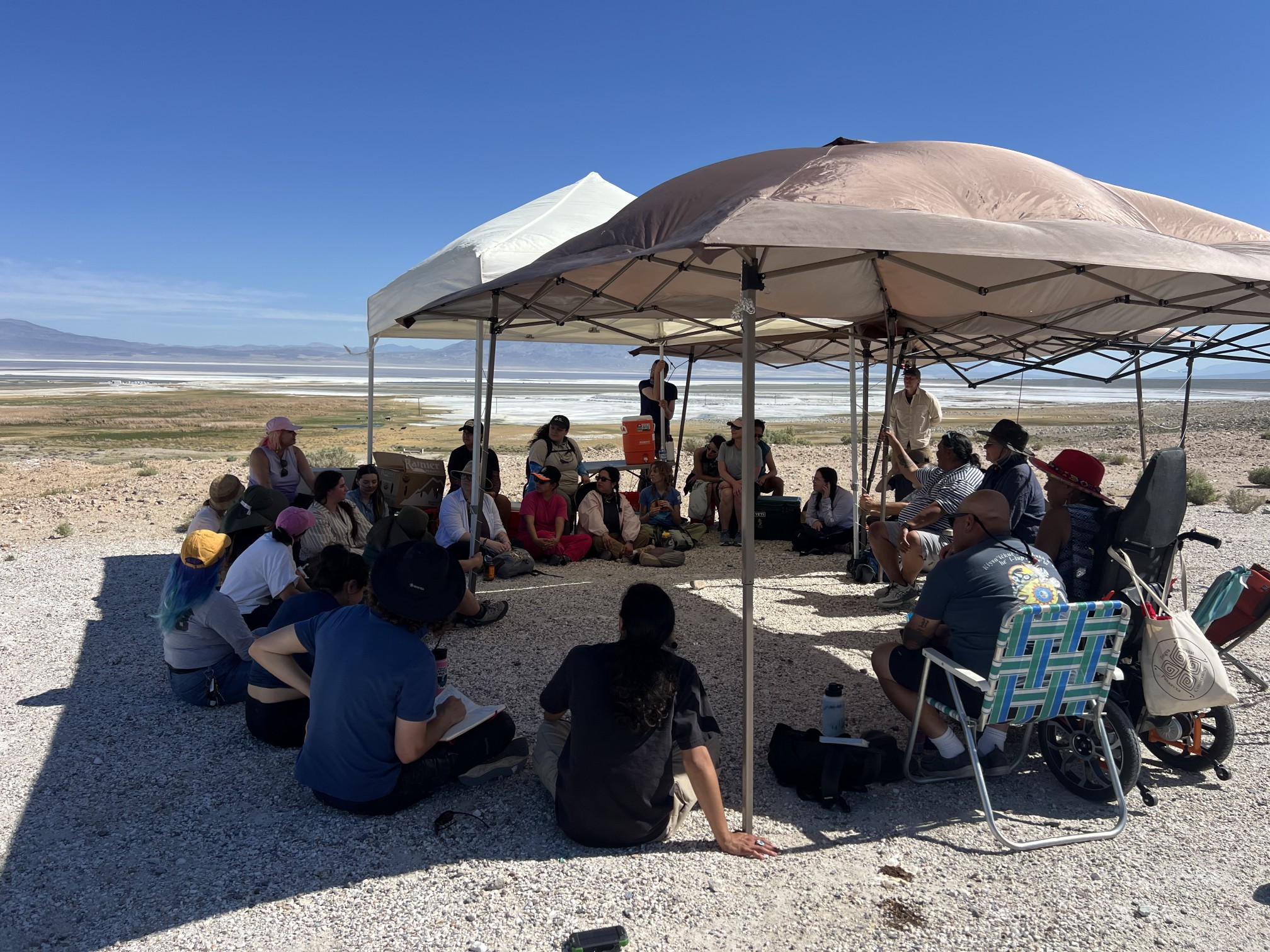
In late March, we held the ‘Coalition Building’ walks planned for September 2025 that had to be canceled due to intense wildfire smoke. We walked with 35 people from organizations in Los Angeles and Payahuunadü that are at the frontline of water protection work. The purpose was to deepen those relationships among individuals, organizations, and the waters. With a small support team, we walked for three days at meaningful locations in Payahuunadü, and then sat in circle together to share reflections and learn from each other.
Our intention with the walks we hold in both Payahuunadü and Los Angeles is to contribute to the restoration of relations between the source (Payahuunadü) and the end user (Los Angeles).
For over a hundred years that relationship has been one of extraction and manipulation. Now, in the era of polycrisis, we have both the opportunity and necessity to heal that relationship. We see healing as being guided by Indigenous knowledge that invites human beings (and institutions/organizations) to become part of the greater circle again — with lands, waters and the more-than-human world. A wisdom that asks us to again live within our means, be in active relationship with our local surroundings, and remain accountable to our families, neighbors and communities.
Returning to Payahuunadü
A Reflection from the Relationship Building Walk
March 2026
By Devon Provo
with Kyndall Noah and Kate Bunney
My colleagues and I are driving up Highway 14, Los Angeles in the rearview, when the aqueduct comes into view. We’re following its path north to the Eastern Sierra to join a three-day walk at the source of one of the most contentious water conflicts in the United States. This walk was originally meant to take place in September 2025, as a subset of a three-week Lake to Lake journey to acknowledge Walking Water’s ten-year anniversary. It was interrupted by the Garnet Fire. Dangerous conditions and poor air quality forced the evacuation of the first group of walkers mid-journey, and the remainder of the walk was cancelled to protect participants’ health.
The bleak irony was not lost on us. A walk meant to bear witness to an ecological crisis could not be completed because of an ecological crisis.
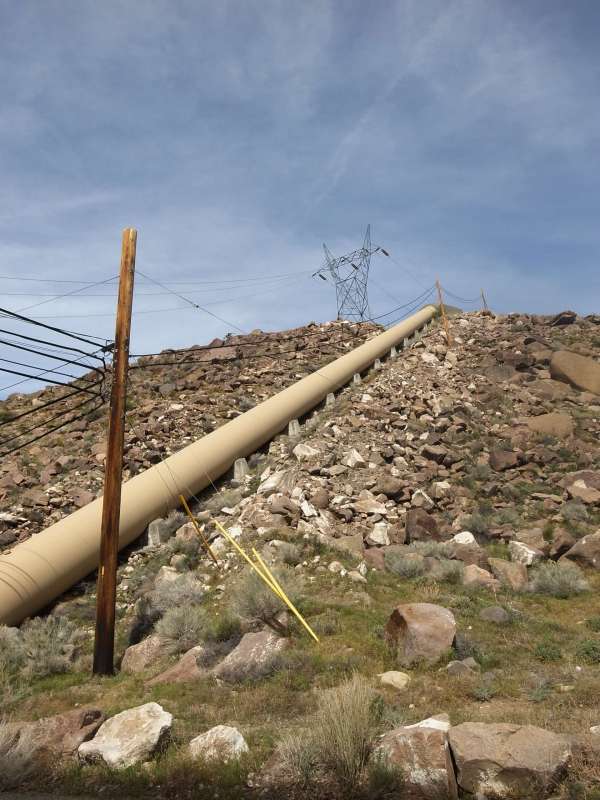
Photo by Alisa Petrosova
Now, in March 2026, we’re reconvening to try again. Only a few months have passed, but the ground beneath us has fundamentally changed. Kathy Jefferson Bancroft, a respected and deeply loved elder and former Tribal Historic Preservation Officer for the Lone Pine Paiute-Shoshone, passed away in January. She was a fierce water protector and a gentle teacher. She saw Patsiata in its wholeness and spent her life helping others see it too. She is impossible to replace. Andy Lipkis, who inspired many in Los Angeles to re-evaluate the city’s relationship to water, has stepped back into retirement. There’s a new generation of walkers joining the fold as elders move on, but the sacrifices required to show up are not shared equally. Gathering at all these days is a risk. Regressive policies and brutal enforcement actions make it increasingly dangerous to carry out daily activities, let alone to witness and document the events unfolding around us.
The magnitude of the trouble we’re in is overwhelming. We get out of the van and shuffle our feet.
Day 1: Jackrabbits
We gather at noon alongside Patsiata (Owen’s Drained Lake), sharing lunch thoughtfully organized by Jenny Kane and donated by local businesses. Birds circle in formation overhead, their wings flashing from black to silver as they catch the light. Behind them, the mountain peaks stare back at us, bare and exposed. It’s only March, but there is little snowpack to be found and instead we are experiencing a heatwave. We notice.
Scott Davidson moves through the group before we begin, discreetly checking in with each walker about their safety needs. He is unhurried and listens more than he speaks, providing deep presence and attention to each person.
Kate Bunney and Kyndall Noah bring us together in circle for an opening ceremony. Jeremiah Joseph, Charlene Buff, Jolie Varela, Alan Bacock, Annie Mendoza and Kyndall share stories of Kathy’s wisdom, her tenacity, her humor, and what it means to continue in her absence. Jolie offers a song in her memory. Somehow, the work must continue. Even when those who led us to this path are no longer here to show us the way.
The Tibetan Monks of Gaden Shartse Phukhang, who have come to Payahuunadü as part of their Sacred Harmony World Peace Tour, sing a prayer for the return of the waters to Patsiata. Tina Calderón, a Tongva culture bearer and elder, offers a closing prayer. Then we descend towards the dry lakebed, taking the first stretch of the walk in silence. Silence makes the strangeness of this place easier to see – the engineering and the ecology superimposed in sharp contrast.
Jeremiah, a member of the Lone Pine Tribe, Cultural Resource Protector, and Land Restoration Specialist, orients us to our surroundings. The cracked earth we see was once a lake. It is drained because of a series of decisions made far from here, for the benefit of people who do not live with the consequences. People like me.
In the place of that lake, LADWP has installed nearly 30 square miles of sprinklers as a required mitigation for the toxic dust that overpumping leaves behind. Payahuunadü/the Owens Valley is now one of the most air-polluted regions in America and must be actively managed to control hazardous dust emissions. Rather than allowing lake levels to recover, LADWP’s strategy is to spray water to dampen the lakebed it keeps drained. We squint at the sprinklers as if narrowing our vision might help us make sense of the damage these extreme levels of extraction have created.
Jeremiah reminds us that water moves through us, too. In grief and in tears. We begin to walk back to our starting point, and a jackrabbit startles and runs away as we pass. Which is the wilder thing, the jackrabbit or the institutions that believe these policies are rational?
We circle up again, our faces now hot and caked with dust and salt. Jeremiah tells us about his work on dune restoration, and about the way governing agencies have divided the major dune areas into numbered zones. Zacarías Bernal (Tia Chuchas) will later say it feels like a prison system, where landscapes, like inmates, are assigned a number instead of a name. Despite this, Jeremiah and the restoration crew from the Lone Pine Paiute-Shoshone tribe have achieved strong plant survival rates – not by prioritizing arbitrary quotas for the number of plants shoved into the ground, but by cultivating genuine intimacy with the land and listening to what it needs.
Kate and Kyndall then invite each person to share their intentions for the days ahead. People speak of their willingness to learn and unlearn, of the desire to move beyond extractive frameworks – in water policy, but also in how we show up with one another. Kathy’s name comes up again and again, as if she were only a phone call away. Annie Mendoza shared that it felt more like ‘relationship building’ than ‘coalition building’, and we began exploring what deep relational work means when we are representing peoples both from the source and the end-user. The relationship between Payahuunadü and Los Angeles has, for over 100 years, been one of extraction – an unhealthy relationship that has created a deeply impacted environment, disenfranchised peoples and a bleak future. What does accountability mean? And accountable to who? How do we create relationships without extraction? How has scarcity thinking brought us to where we are now? What are the racial and cultural disparities that we need to acknowledge and work to dismantle? Are we prepared to walk with these uncomfortable themes?
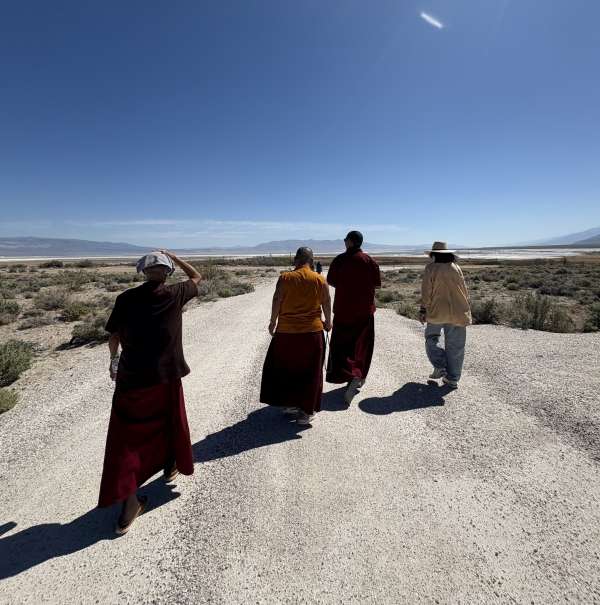
Photo by Devon Provo
Day 2: Energy
We meet at the LADWP Power Plant north of Bishop, where Jen Bravo (ARLA) shares what she learned about the operations from an LADWP pamphlet. The kinetic energy of water moving downhill is captured here and converted into electricity to be sent to Los Angeles. Captured. The water’s migration, intercepted. Water and Power are interwoven themes in California’s water story – roughly 12% of California’s total energy use is required to move and pump water from source to end-user.
We walk along the Lower Owens River gorge and the water is very still. Azeneth Martinez (LA Nature for All) says it looks like a mirror and she’s right. It shows us what we’ve made of this place, and the reflection is unflattering. How do we restore our relations with water?
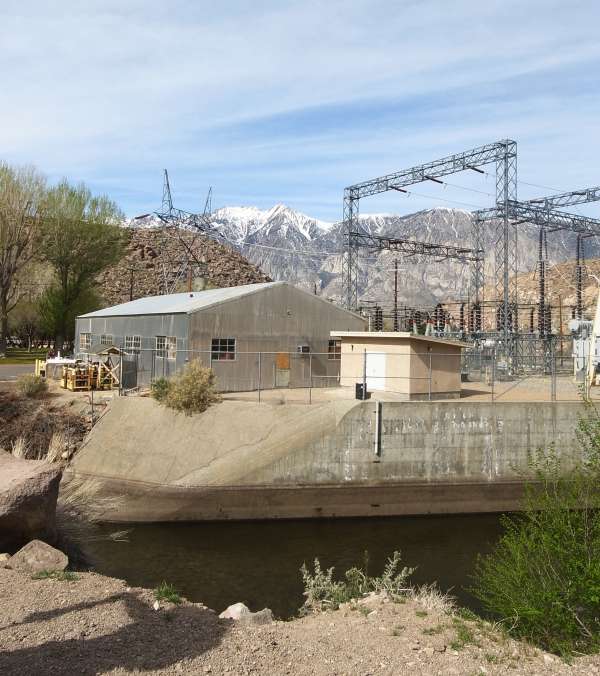
Photo by Alisa Petrosova
We head toward Pleasant Valley Campground, with leadership taking different forms along the way. Kate shows us the route from the front. Scott brings up the rear, making sure no one gets left behind. Sunscreen and snacks and water are exchanged freely and we all are deep in conversation. We arrive at the campground to find shade tents already assembled, lunch ready (another donated meal from a local business), chairs arranged. Our needs have been taken into consideration. We gather together next to Owens River.
In circle, Kyndall Noah describes how Payahuunadü has long functioned as a sacrifice zone, where water, land and communities (especially the local Indigenous communities) have been depleted to support the ongoing growth and urbanization of Los Angeles. This history has allowed for the gradual desertification of the valley while water and power are concentrated in the south.
Roughly 350 people in Payahuunadü/the Owens Valley are employed by LADWP, which offers above-average wages and benefits for the area, making its positions highly sought after. This desirability also causes disputes amongst the local communities, disrupting the social fabric and putting job seekers in a difficult position. This is just one example of an institution that is unaware of the impact they cause in local communities. Some of us in the circle are beneficiaries of this arrangement, others are directly harmed by it. We sit with that reality.
There are many forms of energy that are extracted from this place. Hydropower, for one. But also the energy it takes to contest each policy decision, to travel 267 miles south just to provide a two-minute public comment in front of the LADWP Commissioners, and to keep educating Angelenos who do not know where our water comes from or what it actually costs.
Many of these costs are not accounted for in any mitigation plan, but they are present here. They appear in the declining health of elders who have given decades to this work, in creative lives and passions put on hold, children’s sports games and recitals missed, hatchlings that can not reproduce, vegetation suffocated by dust, family businesses and ranchers who cannot plan for the future, and the ceremonies, foodways and practices that have been disrupted and destroyed. Any small positive steps seem to be hard fought for.
We talk about how important it is for Angeleno’s to show up, and to use their voices to challenge the status quo. We are also reminded that for some communities it is not currently safe to do that.
In the evening, we expand our circle and invite other neighbors and members of the local community to join us for a potluck, including others dedicated to water protection and food sovereignty. We enjoy a shared meal as kids sneak desserts and play by the river until the sunset slips over the horizon.
Day 3: Loopholes
We meet at the Fish Springs Fish Hatchery, where Noah Williams (Eastern Sierra Land Trust) tells us about the disappearance of the natural springs from this location and the compounding impacts of the hatchery and LADWP’s ongoing groundwater pumping.
The story is full of bureaucratic maneuvering. The Long Term Water Agreement was meant to limit LADWP’s groundwater extraction, but Wells 330 and 332 have been classified as exempt. It is these wells that fuel the hatchery operations, which are managed by the California Department of Fish and Wildlife (CDFW). Even the wastewater from the hatchery is not returned to the springs. Instead, it flows onto land owned by LADWP, where it is funneled into the aqueduct and sent south to Los Angeles. A 1990 effort to modernize the well system coincided with the timing of refurbishments to the Los Angeles Aqueduct. The valley remains no closer to the 12% reduction in groundwater pumping it was promised.
The hatchery itself is a mitigation, meant to offset the economic impact of water extraction on the local tourism industry. Because local waterways have been drawn to such dangerously low levels, fish here struggle to reproduce naturally. So, CDFW breeds non-native trout to stock the streams. Visitors who travel here to fish experience the illusion of nature. The Owens pupfish, native to these waters, remains endangered.
Where the natural springs once flowed, there are now two concrete tanks holding fish in appalling conditions. A dead fish lies rotting on the ground outside the tank. Inside, another swims with one eye missing. Many are visibly disfigured.
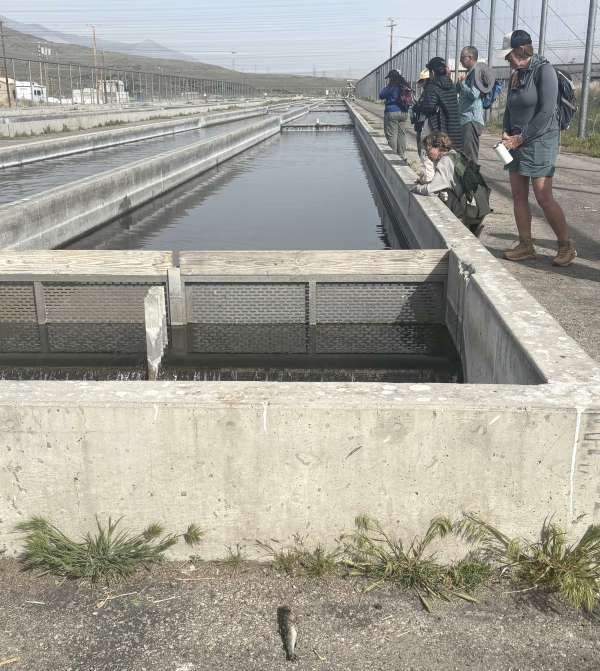
Photo by Devon Provo
To raise the fish, thousands of eggs are harvested from a single female, producing such little genetic diversity that the ones that hatch are mostly sterile and prone to disease. In 2020, a bacterial outbreak killed 3.3 million fish across three state-run hatcheries. CDFW had to disinfect the tanks, which forced LADWP to temporarily pause the groundwater pumping. For a few brief months, the water table rose, only to be pumped away again when the outbreak was resolved.
Mitigations and exemptions, reclassifications that amount to nothing. Every loophole seems to open onto another. There is a specific way of thinking, with extractive logic, quotas, and technicalities that keeps recreating the same failures at every scale.
Walking Water hasn’t gathered us here to develop a plan, but to stand face to face with what the plans produce.
We walk three miles to Three Creeks where the land, cared for by Indigenous stewards, is teeming with life. There are minnows darting in between cattail reeds in the pond, and rabbitbrush along the edge being attended to by bees.
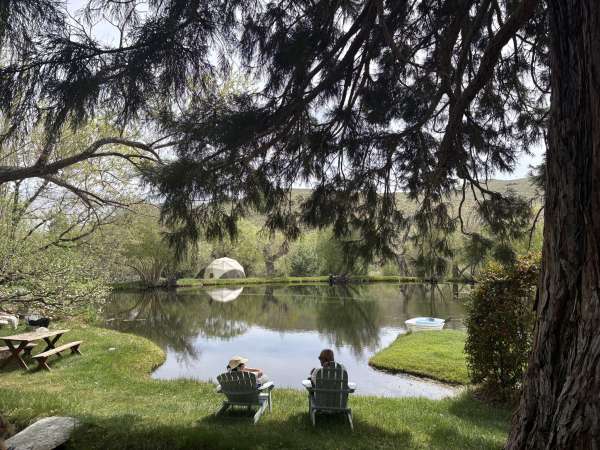
Photo by Devon Provo
We gather for a closing circle. Kate and Kyndall invite us to reflect on themes of abundance and scarcity, what we can bring to this work, and what we might need. We’ve developed some intimacy with one another over the last few days and it seems easier to say difficult truths – and to truly listen to them. We are not leaving with answers or action items, but with a different way of relating, one that opens new possibilities for tending to water with respect for the dignity of all life.
Driving south on Highway 395 through Lone Pine, my colleagues and I pass a billboard from Friends of the Inyo that asks: What happened to the water?
Our feet are tired, our lips are chapped. We know what we saw.
We follow the aqueduct’s path south until Los Angeles comes into view. As we pass the Cascades, the water reappears, the same water that had traveled all those miles from Patsiata in a pipe.
Organizations represented:
Owens Valley Indian Water Commission, Walking Water, East Yard Center for Environmental Justice, Friends of the Inyo, Sacred Places Institute, Three Creeks Collective, ARLA, River in Action, LA Nature for All, Tia Chucha’s Centro Cultural and Bookstore, Spherical, Heal the Bay, LA Waterkeeper, Eastern Sierra Land Trust and Watershed Progressive.
Walkers quotes:
“Working across colonial water geographies is complicated, and there has been a harmful pattern established in the environmental circles that tokenizes Indigenous groups and people of color. In this moment, we have the responsibility and power to reject old cycles and to be guided by Indigenous values, including radical relationality and reciprocity. In order for us to successfully oppose these colonial water systems and their management, we must transform the relationships we practice with each other. Being able to walk along Patsiata with relatives from Tovaangar and Payahuunadü is a necessary step in the decades-long process of healing in both regions.” ANNIE MENDOZA, Owens Valley Indian Water Commission
“Our walks and our talks in Payahuunadü offer people an opportunity to step into accountability. The stories we share and the experiences we carry become a responsibility for those we choose to gift them too. For me, this walk was more than building relationships. It was about naming truths that are too often left unstated. It was about recognizing the work happening in under-resourced communities, the resilience it demands, the sacrifice it requires, and the honor and responsibility that come with carrying that work forward. This walk was not only about responsibility to the people of Payahuunadü, but about calling those who joined us to move beyond awareness and show up as true accomplices.” KYNDALL NOAH, Owens Valley Indian Water Commission
“Visiting Patsiata reminded me of the global struggle for Indigenous sovereignty and the fight against water colonialism. From Palestine to Turtle Island, the land is demanding its freedom. As are the people. I’m inspired and forever indebted for this experience. It’s one everyone needs.” YESSENIA FUNES – Spherical
“The walk was regenerative because the people, conversations, truth-telling and the literal walking all felt like a re-tuning and maintenance to my mind, spirit, values and inner fire to carry on. It was a pleasant contrast to all the devastation, violence and war we are experiencing in our neighborhoods and across the globe.
I left wanting to do more intentional collaborative work that is grounded in reciprocity and genuine relationships. It takes a different kind of energy, it moves at a different (often slower) speed, and asks for deeper vulnerability and honesty. It’s hard to do when everything is so urgent all the time, and when there are so many commitments– but it’s the most meaningful in my opinion.” CINDY DONIS – Community Organizer, East Yard Communities for Environmental Justice
“Connecting with individuals and communities committed to restoring the relationship with water has been incredibly transformative. The difficult conversations highlighted the importance of reciprocity, responsibility, and complacency. On a deep level, Walking Water has helped replenish my belief in the possibility of creating better futures.” ERICA MACEDA – Executive Director, River in Action
“The work of Walking Water honors the truth that the act of walking itself is a huge part of how humans think, create, and process our experiences. Walking with intention, in community, and with accountability to the humans, beings, and places of Payahuunadü is a challenge to put that understanding to work for justice.” ERIK LOYER, Creative Technology Director, Spherical
“One thing that we talked about that has really resonated with me as I returned home was what it means to be rich in spirit. How wealth can mean many different things, but that the character and abundance of our spirit is something worth protecting. I’ve also found myself focusing on is reciprocity and how I would like to be better at practicing that both personally and in my work.” STEPHANIE GEBHARDT RATH – Senior Watershed Specialist, Heal the Bay
“It was great crossing paths, walking, and learning with you all.
Some questions I am still walking with are what more can be done to return to sustainable water ways? To what extent is the damage LA DWP has done reversible, and how much is not? In addition to constant education and making our voices heard where decisions over water are made, what other tangible and practical actions can we take so DWP no longer has authority over the land? And is that even a goal?” ZACARÍAS BERNAL – Program Assistant, Tia Chucha’s Centro Cultural and Bookstore
Financial Info:
We received $4,250 from participating organizations and spent $8,400.
Our expenditure is broken down as: $4,100 to Indigenous Advisors, $3,000 to logistics team, $500 for food, $300 for equipment, $300 for travel and $200 for Insurance.
Much gratitude to ARLA for providing travel support for the L.A. based community members to join the walk.
We also received in-kind donations from Astorga’s Mexican Restaurant, Mountain Rambler Brewery, Grocery Outlet Bishop, Wholefoods and Von’s Bishop.
Much gratitude for all we have received to make the walks possible.
Next Walks
Our next Walks of Resilience and Accountability will be in Los Angeles, October 23-25, 2026. More details coming soon.
Devon Provo is Senior Manager, Planning & Program Alignment with Accelerate Resilience L.A. (ARLA)
Kyndall Noah is Communications Specialist with Owens Valley Indian Water Commission
Kate Bunney is Coordinator with Walking Water